
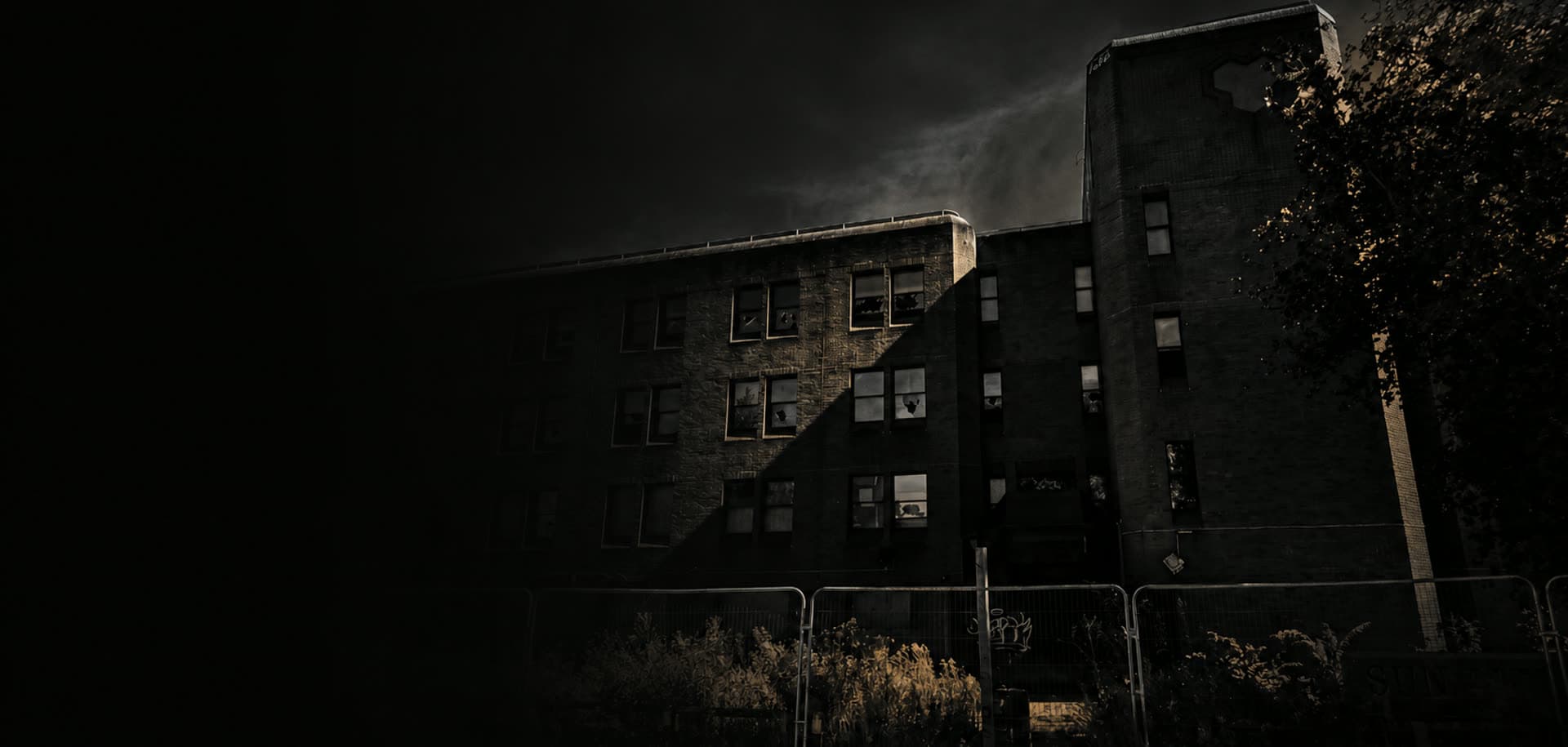
Protecting empty property before it becomes a problem
Vacant property quickly attracts trespass, vandalism, theft and antisocial behaviour. Luxe Security Group provides professionally managed security for vacant, derelict and high-risk premises — protecting vulnerable buildings, controlling access and giving owners clear operational oversight while the property stands empty.
Vacant doesn't mean low risk.
The moment a building is visibly unoccupied, its risk profile changes. The people who notice first are rarely the ones you want inside it.
How empty buildings deteriorate
01Small failures escalate fast
A damaged fence panel or a single broken window tells everyone watching that nobody is responsible for the building. What starts as casual trespass becomes repeated entry, then occupation, stripped fixtures and serious damage — each stage harder and more expensive to reverse than the last.
The response
02A visible, managed presence
A professional security presence changes the calculation for anyone watching the property. Luxe officers deter entry, control who reaches the building, identify developing risks on patrol and respond early — so minor incidents are dealt with before they become expensive problems.
Security built around the property
Manned guarding is one part of it. The wider job is protecting the building, controlling access and reducing risk for as long as it stands unoccupied.
Manned Guarding
SIA licensed security officers deployed to the property as a visible, professional presence — briefed on the building, its vulnerable points and exactly who is and is not authorised to be there.
Static Security
A fixed security position at the entrance or another agreed point, giving the property a permanent point of control for the hours the risk demands — including overnight and 24-hour cover.
Access Control
Managed access for contractors, maintenance visits and approved visitors — identification checked, attendance recorded, and nobody on the property without a reason to be there.
Security Patrols
Internal and external patrols of the building and its grounds, patterned to cover the vulnerable points without becoming predictable to anyone watching the property.
Perimeter Monitoring
Regular inspection of fencing, gates, doors, windows and known weak points, so damage and attempted entry are found and reported early — not discovered weeks later.
Incident Response & Escalation
Escalation procedures agreed with you before deployment. Incidents are dealt with, documented and communicated to your nominated contacts — never left as word of mouth.
Security against the risks vacant property attracts
Every one of these starts small and compounds while nobody is watching. A managed security presence is there to stop them at the first stage.
Trespass & Squatting
Unauthorised entry that can escalate into occupation — far harder and more expensive to resolve than it was to prevent.
Vandalism & Criminal Damage
Broken windows, forced doors and interior damage that compound quickly once a building looks unwatched.
Theft of Metal & Fixtures
Cable, copper, pipework, boilers and fittings — stripped from empty buildings because nobody is there to stop it.
Arson & Fire Risk
Empty buildings are disproportionately targeted, and a fire in an unoccupied property is rarely caught early.
Antisocial Behaviour
Gatherings and misuse of the site that affect neighbouring residents, businesses and the property’s standing.
Urban Exploration
People entering the building for access itself — creating liability, publicity and a map for others to follow.
Fly-Tipping
Waste dumped on open or poorly secured land, with removal costs falling on the property owner.
Perimeter Breaches
Damaged fencing, forced gates and insecure openings — the small failures every other risk enters through.
More than a guard at the gate.
A security officer is only effective when the operation behind them is properly managed. Every vacant property assignment runs on the same operational spine — from officer selection through to the reports that reach your inbox.
Why this matters
Supplying a person to stand at a property is easy. Taking managed responsibility for protecting it — knowing who is deployed, what they are instructed to do, what they found on every patrol and who was told about it — is what actually reduces the risk.
- Officer selection for the assignment
- Site-specific briefing before deployment
- Written assignment instructions
- Defined patrol requirements
- Agreed access procedures
- Clear escalation procedures
- Management oversight of the assignment
- Documented reporting to your contacts
Security starts with the site.
Before anyone is deployed, we understand the property itself — because the right provision for a sealed warehouse is the wrong one for a derelict building with an open boundary.
What we learn is written into the assignment instructions the officers work to — so the cover reflects the actual property, not a generic guarding template.
- Size and layout of the property
- Boundaries and entrances
- Existing perimeter security
- Vulnerable points
- Previous incidents
- Assets remaining in the building
- Neighbouring residents and public access
- Contractor and maintenance access
- Hours of cover required
- Escalation contacts
Assess. Secure. Manage.
Three stages, one accountable operation — from the first walk of the boundary to the ongoing management of the assignment.
Assess
We visit the property with you — boundaries, entrances, existing security measures, previous incidents and what remains inside — and agree what the security operation needs to achieve.
Secure
Officer deployment, hours of cover, patrol requirements, access procedures and escalation contacts are written into site-specific assignment instructions, and licensed officers deploy against them.
Manage
Deployment is where our work starts, not ends: supervision, documented reporting and regular review, with the provision adjusted as the property’s situation changes.
Security for property in every kind of limbo
Property managers, developers, managing agents, housing associations, local authorities, commercial landlords and insolvency practitioners — anyone responsible for a building that is standing empty.
For days, months or until the site changes.
Security needs change as a property moves through its lifecycle — cover can start quickly, scale with the risk, and stand down when the situation changes.
The arrangement evolves as the property’s situation changes — scaled up when the building is at its most exposed, adjusted when contractors arrive, and stood down when the site moves into its next life.
Looking after an active construction site instead?
View Construction Site SecurityFrequently asked questions
Common questions about our vacant property security service.
Can you provide 24-hour security for a vacant property?
Yes. Cover is built around the risk profile of the property — overnight guarding, daytime presence while contractors are on site, or continuous 24-hour cover where the building or its contents justify it.
Are your vacant property security officers SIA licensed?
Personnel carrying out licensable security activities are required to hold the appropriate SIA licence, and we verify licences before deployment. Licence status is also re-checked on an ongoing basis as part of our compliance process.
Do you provide short-term as well as long-term cover?
Yes. Some properties need security for a matter of days — after a sudden closure or a break-in — while others remain protected for months while a sale, redevelopment or demolition works through. The same managed approach applies to both.
Can officers control contractor and visitor access?
Yes, where this forms part of the agreed assignment instructions. Officers can check identification, record contractors and approved visitors in and out, and refuse entry to anyone not authorised — so you always know who has been inside the building.
Do officers patrol the property?
Yes. Internal and external patrol requirements are set from the layout and identified risks of the property — the perimeter, entrances, vulnerable openings and any areas holding remaining assets — and observations are escalated in line with the agreed procedure.
Which areas do you cover?
We operate across London and the Home Counties, with the capacity to deploy briefed officers throughout the South East.
Can the security provision change over time?
Yes — and it usually should. A newly vacated building, a property under offer and a site awaiting demolition each carry different risks. We review the provision as the property’s situation changes and adjust the cover accordingly.
Get Started
Don’t wait for the next breach.
Tell us about the property, its current state and what has already happened there. We’ll assess the site and put a managed security arrangement around it — or call us on 020 3633 6472.
Protect the property while it stands empty
Whether the building has just been vacated or has stood empty for years, speak to Luxe Security Group about a managed security arrangement built around the site.